Does the Iconic Trendsetter Rangeela Still Hold Up
Does the Iconic Trendsetter Rangeela Still Hold Up
Thirty years ago, when India was still adjusting to the rush of economic freedom and cultural change, Rangeela burst onto the big screen like a rebellious anthem. Ram Gopal Varma’s vibrant tale of a street-smart dreamer and an aspiring actress felt like a creative uprising—raw, rhythmic and radically different. It marked a breakaway moment, steering Hindi cinema away from heavy melodramas and into the lively, chaotic realm of aspiration, romance, and realism.
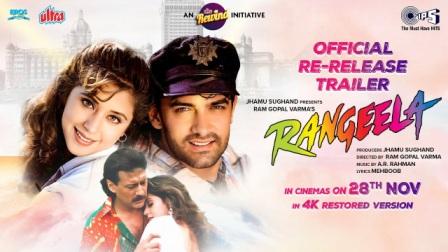
Now, as the film returns to theatres in a remastered 4K release on November 28, the question inevitably rises: Can a cult favourite born in 1995 still shine in 2025’s era of unforgiving scrutiny? Or will the outdated attitudes of its time overshadow the magic that once reshaped Bollywood? – Does the Iconic Trendsetter Rangeela Still Hold Up
Memories from the Projection Booth
Raj Kumar Mehrotra, manager of Delhi’s iconic Delite cinema (later transformed into a twinplex), still remembers the contagious buzz surrounding the movie’s premiere. “Aamir Khan wasn’t the star he is today,” he recalls, reflecting on the man who embodied the lovable tapori, Munna. “It was Rangeela that pushed Aamir toward mainstream stardom.”
Director Ram Gopal Varma, too, was far from a household name back then. “Before Rangeela, RGV was not widely known among the general audience,” Mehrotra adds.

Three decades later, the re-release arrives at a time when viewers swim in an ocean of OTT content. “Audiences now expect constant novelty,” he says. “Films that strike a chord with young viewers still do well in theatres, but the competition is immense.”
Yet Rangeela still throbs with an energy that feels timeless—equal parts vulnerability, fire, and Mumbai-city grit. It’s less a relic and more a reminder that some stories grow richer with age. – Does the Iconic Trendsetter Rangeela Still Hold Up
The Film That Rewired Modern Bollywood
Rangeela didn’t just entertain—it reinvented. Its influence can still be felt across Bollywood, through five creative leaps that completely altered the cinematic landscape.
Urmila Matondkar’s Mili shattered the stereotype of the ornamental heroine. She wasn’t a damsel or decoration—she was ambitious, self-assured, sensual, and unapologetically driven. Her portrayal marked a shift toward women who shaped their own destinies on-screen.
Then came A.R. Rahman’s musical revolution—a storm of synths, Sufi-inspired layers, and global rhythms. His soundtrack broke away from formulaic Bollywood tunes, pushing composers to think beyond borders.
WB Rao’s visuals painted Mumbai in surreal hues—neon pinks, buzzing blues, and dreamlike textures. The city became a living character, chaotic yet poetic.
Ahmed Khan’s choreography, influenced heavily by the MTV generation, infused Bollywood dance routines with urban swagger, hip-hop undertones, and youthful energy. He recalls the creative intensity in an interview with India Today:
“Every song needed a different style. I was young, so Rahman’s music spoke to me in a way older choreographers couldn’t connect with. Translating that sound onto the big screen gave me sleepless nights—but it was thrilling.”
Finally, Manish Malhotra’s costuming ushered in a fresh fashion era. Sleek silhouettes replaced heavy embroidery, and glamour became youthful, modern, and aspirational—laying the foundation for Y2K Bollywood styling. – Does the Iconic Trendsetter Rangeela Still Hold Up
A Legacy Still Felt in Today’s Cinema
Producer and trade analyst Girish Johar sees Rangeela’s impact still echoing today. “Urmila struck a chord with the younger audience. The film reflected changing attitudes in a post-liberalisation India,” he says. Her glamour, combined with relatable ambition, sparked a cultural shift.
He also credits the film’s lasting power to its sensational music. “Musical love stories often resonate deeply. Films with strong soundtracks generally perform well,” Johar explains.
That legacy continues in modern romances like Tere Ishk Mein, where stars like Dhanush and Kriti Sanon chase the same mix of fiery passion and melody-driven storytelling that Rangeela mastered first.
Three decades later, the world has changed—but Rangeela’s spirit remains as luminous as ever. Whether through music, style, or the raw heartbeat of Mumbai, its legacy still colours Bollywood’s present, proving that some classics don’t just survive time—they transcend it.